Monday, March 9, 2015

Sunbutter and Jelly Cookie Bars


Even though I grew up with a severe tree nut allergy, that didn't mean that I couldn't enjoy peanuts.  And I did enjoy peanuts!  Perhaps not as much as my husband, but I routinely enjoyed lots of peanut products.

Back in the days when hubby and I ate peanuts without a second thought, my mom gave us a recipe for peanut butter and jelly cookies.  I haven't made it in years, of course--I'm not about to make peanut protein airborne in our house.  I pulled the recipe out a little while back though, with the intention of converting it to Sunbutter.

Don't forget that our Peanut Allergy Slap
Bands are available now!!  Click here!
This proved to be more difficult than I'd anticipated.  I'd forgotten, but the original recipe relied heavily on prepackaged cookie doughs and frostings--things I've been leaning away from even when they are allergy safe.  I'm a bit of a cookie snob, even before I had to bake egg-free, so scratch cookies are the way to go!

It took some experimenting and learning from mistakes, but I finally figured out a great combination that mimics the original cookie but with an allergy-safe twist!

Sunbutter and Jelly Cookie Bars

Cookie Ingredients

  • 1/2 cup granulated sugar
  • 1/2 cup packed brown sugar
  • 1/2 cup creamy Sunbutter
  • 1/2 cup butter or margarine, softened
  • 1 Tbsp water
  • 3 Tbsp vegetable oil (I use canola)
  • 2 Tbsp ground flax
  • 3/8 cup (or 6 Tbsp) water
  • 1 1/4 cups all-purpose flour
  • 3/4 tsp baking soda
  • 1/2 tsp baking powder (corn-free variety, if needed)
  • 1/4 tsp salt

Directions
In a small bowl, mix the ground flax with 3/8 cup (6 Tbsp) water.  Allow to sit for a few minutes.  (If you aren't egg-free, this is to mimic 2 eggs.)

Mix the flour, baking soda, baking powder, and salt in a medium bowl.  Set aside.

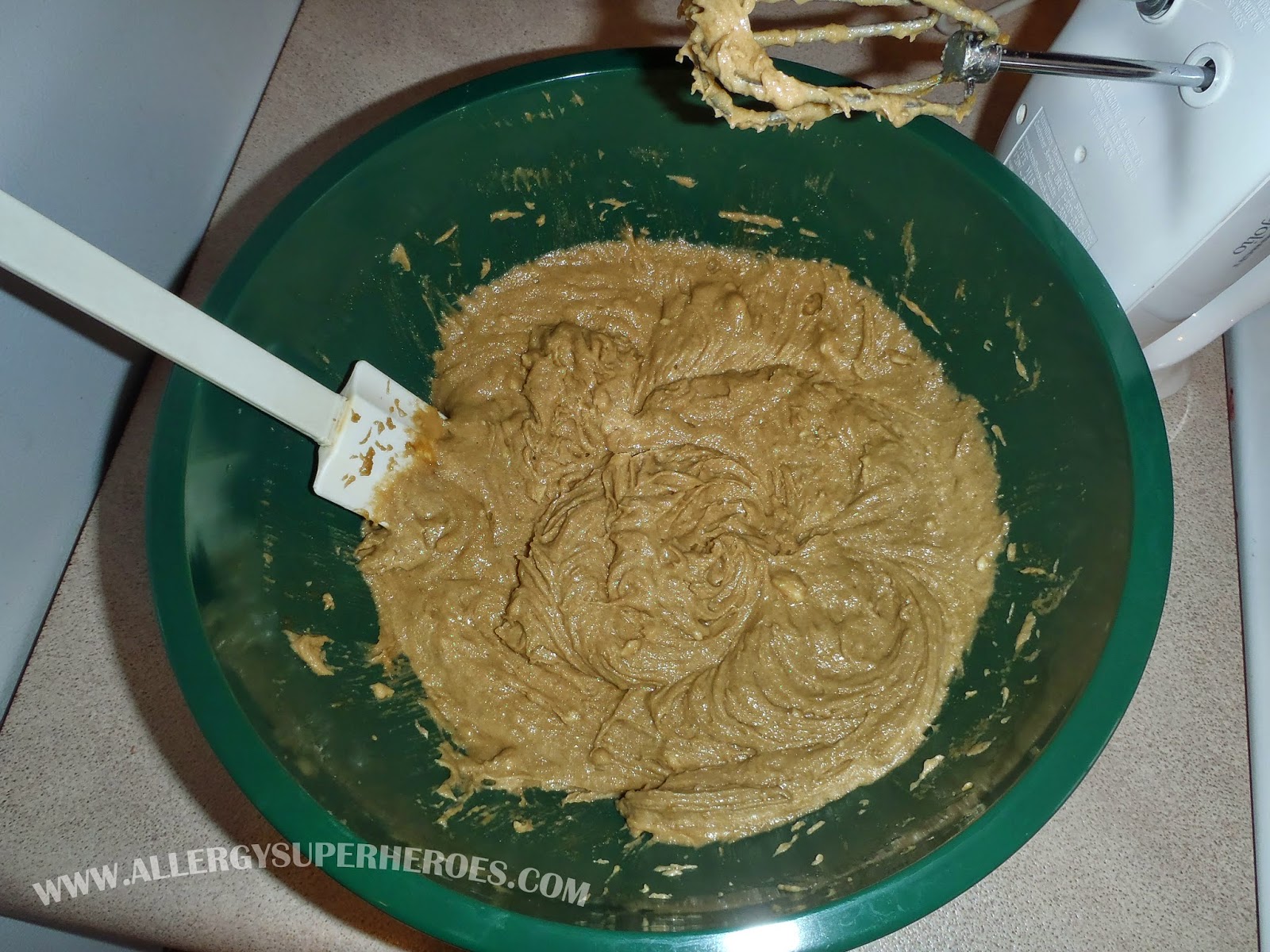
In a large bowl, mix sugars, sunbutter, butter, remaining 1 Tbsp water, vegetable oil, and flax mixture.

Gradually add the dry ingredients.

Grease or spray the bottom of a 9x13 pan.  Press the dough into the the pan, being sure to spread it evenly.

Bake at 350 degrees for 15-18 minutes, until the edges are light brown.

Cool completely.


Topping Ingredients

  • One batch (roughly 1 lb) of your favorite allergy-friendly frosting.  I used a 3/4 batch of my Cream Cheese frosting.  You can even use a can of store-bought frosting if you like.
  • 1/4 cup creamy Sunbuter
  • 1 Tbsp milk *optional*   If you're using a store-bought frosting or your homemade batch is particularly stiff, add 1 Tbsp milk to offset the thickness of the Sunbutter*
  • 1/4 cup strawberry jam

Directions

In a bowl, stir frosting, *milk*, and Sunbutter until well blended.

Spread over cooled cookie base.

Place jam in a bowl and stir to break up lumps.  Drop by spoonfuls over frosting.

Swirl jam for a marbled design with the tip of a knife.  Refrigerate for 20 minutes or until frosting is set.

Enjoy!  We sure did!


Linking up at Allergy Free Wednesdays and Corn-free Everyday
  realfoodallergyfree

Wednesday, March 4, 2015

Allergy Study

Zax and I participated in a food allergy research study last week!


As studies go, it was quite simple. We gave some preliminary medical history over the phone so the doctor could decide if he wanted our blood.  Once he decided that he did, we came in. From there, it was a simple questionnaire about our allergic history and a blood draw.  Easy Peezy!

Our Peanut Allergy Slap Bands are available now!!
Click here!
Zax has never been all that good with needles, so I started prepping him a few days before.  I told him that the study doctor wanted to try to figure out why people have allergies, and since we do, our blood can help him figure that out.  I also told him that maybe someday the information the doctor learns from our blood might help find a cure. Zax needed the word "cure" defined, and as soon as I finished doing that he exclaimed "I want that!"  This still makes me smile.


We had to do our blood draws in different places.  The study was through the University of Colorado Anschutz Medical Campus, but they only draw blood for people 12 and up there.  The study accepts kids as young as 6 with peanut or tree nut allergies (Kal is still too young to participate) so they shuttled us over to Children's Hospital for that.


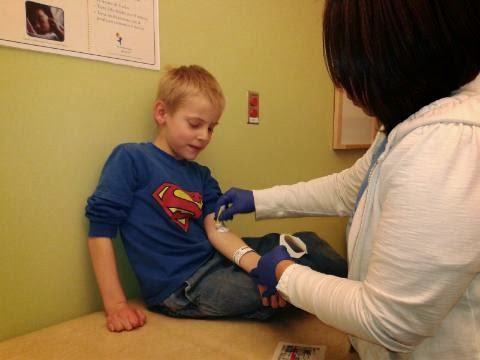
I went first because I wanted Zax, who again isn't very good with needles, to see what was in store. He watched the tech take my blood and took these pictures of the process.


Once we got over to Children's, they gave Zax some numbing cream on the crook of his elbows--both sides, just in case they had trouble with the first side.

I was anticipating having to help hold him still because of how he's been with shots, but he did GREAT! I held his hand while the nurse put the actual needle into him, but after that he allowed me to let go so I could take pictures of him.

I came over to rub his back a few times, but he was absolutely fine.  The only thing he complained about was the tightness of the tourniquet.  I was so proud of my little superhero! I don't know if it was the early prep, the numbing cream, the fact that he knew he was helping people and trying to find a cure, or just that he's getting older, but this is definitely the best that I've ever seen him around needles.  I love my brave kid!

We were very happy to help contribute to this!  Have you ever participated in a research study?


As a matter of fact, this study is still looking for participants.  They have enough controls (non-allergy people) but if you're in Colorado and have a peanut or tree nut allergy, or know anybody who fits that criteria, I hope you will consider participating!

Here's the info, if you are interested:


PEANUT AND TREE-NUT ALLERGY RESEARCH STUDY
Blood Samples for the Study of Peanut, Tree Nut and
Other Food Allergies
COMIRB # 13-2102

We are seeking adults and children who are allergic to
peanuts and/or tree-nuts to donate blood. And
individuals with no known food allergies.

Description: The purpose of this study is to determine how the body’s
immune system interacts with nuts and other foods to cause allergic
reaction.

To be eligible, you must be:

1. 6-75 years of age
2. Have a diagnosis of peanut and/or tree-nut allergy made by either skin
tests or blood tests.
3. Have no known peanut and/or tree-nut allergy.

Participation will include:

1. Donation of a small amount of blood

Financial compensation will be provided after participation in the study.

For information, please call
Spodra Eglite study coordinator
303-724-7193
Principal Investigator: Stephen Dreskin, M.D., Ph.D.
Co-Principal Investigator: Dan Atkins, M.D.

Monday, March 2, 2015

The Best Chocolate Cake


This is a very old cake recipe.  It goes back to the depression era when eggs, butter, and milk were both expensive and rationed, so some genius (who is lost in the annals of history) developed this cake.  I've seen it referred to online as the "Wacky Cake" and the "Less Mess Chocolate Cake" (in which the recipe suggests you mix it all in the cake pan.  I forego this in favor of lining my cake pan to get it out easier.)

I got this recipe from my cousin, who remembered it from an American Girl Cookbook from her childhood (no doubt the American Girl character was from the depression era.) It's a great cake, and one of our favorites.  The batter is runnier than most cakes, and the resulting cake is a little denser, but unless you're comparing cakes side-by-side, it's unlikely that anyone will notice.  In fact, I like the denser texture because I like to sculpt my kids' cakes into fun shapes, and this holds up better than most egg-free cakes.

It's also great for party guests with allergies because it's free of 7 of the top 8 allergens (depending on what oil you use) and is also free of corn (depending on what oil, vanilla, and vinegar you use (substitute something else for white vinegar if you have a severe corn allergy.))  I've even made it with gluten free flour with reasonable results, which would make it free of the top 8!

This cake has been cut to shape for one of my son's
birthday parties.  This is the only un-frosted cake picture I have.

The Best Chocolate Cake

Ingredients:

  • 1 1/2 cups flour (can be gf flour)
  • 1 cup sugar
  • 3 heaping Tbsp unsweetened cocoa powder
  • 1 tsp baking soda
  • 1/2 tsp salt
  • 6 Tbsp vegetable oil (I use canola)
  • 1 Tbsp white vinegar
  • 1 tsp vanilla
  • 1 cup cold water

Our Peanut Allergy Slap Bands are available now!!
Click here!
Directions:
(I apologize for not having step-by-step pictures this time, or even a good picture of an unfrosted cake. I haven't made this in a while, and won't need to make more cakes until at least April, and I didn't take pictures each step of the way before I started blogging recipes.)
  1. Heat oven to 350 degrees.  Line an 8 or 9 inch cake pan with parchment paper.
  2. In a medium bowl, whisk together the flour, sugar, cocoa powder, baking soda, and salt until thoroughly combined.
  3. Make three wells in the dry mixture.  Pour the oil into one, the vinegar into another and the vanilla into the third.
  4. Pour the cold water over all and mix until thoroughly combined.
  5. Pour the batter into the lined cake pan.
  6. Bake for 35-40 minutes, or until a toothpick inserted in the middle of the cake comes out clean.
  7. Remove from the oven and allow to cool somewhat.
  8. Run a knife between the outer edge of the cake and the pan.  Turn upside down onto a serving plate.  Remove the parchment paper and allow to cool completely before frosting with your favorite allergy-friendly frosting

This recipe makes one 8 or 9 inch round, or roughly one dozen cupcakes.  Double it for a 9x13.

I quadrupled the recipe for this Preschool Graduation cake.  It
is two 9x13 cakes put together.

In another week or two I'll share more of the themed cakes I've made with this.  For now, enjoy!

How do you like your cake?

Linking up at Allergy Free Wednesdays, Gluten Free Fridays, and Corn-free Everyday
realfoodallergyfree  

Friday, February 27, 2015

Peanut Free Pinecone Bird Feeders!

Back during Christmas break, I decided to do a bird feeder craft with the kids.  We all know that the traditional pinecone birdfeeder has peanut butter, but considering that birdseed often contains sunflower seeds, I figured birds (and squirrels, darn them) would be perfectly fine with Sunbutter.  So that's what we did!


It was superhero pajama day, in case you couldn't tell.

Zax caught licking the knife!  (The knife that had been spreading Sunbutter on dirty pinecones.  Pinecones that still had some dead bugs on them.  Boys!)

For some reason, I was unprepared for how much of a mess this would make.  Kids with peanut allergies definitely cannot be anywhere near where this has been going on (if they were made the traditional way), not even the next day.  Are the teacher and custodian really going to clean up all that residue?  If either of my sons's teachers ever tells me they want to do this craft, I will firmly state "you're doing it with Sunbutter, or you aren't doing it at all."
The picture doesn't really do the mess justice.  Sunbutter was
smeared all over the table.

Our Peanut Allergy Slap Bands are
available now!! Click here!
Getting ready to roll them in birdseed.  Make sure the birdseed is free of your allergens!  I would also recommend washing hands after finishing, not only to get the mess off, but because I'll bet birdseed doesn't label for cross contamination.


Aren't they pretty?  See, you can do this craft just as easily and nicely without the peanuts!


The squirrels decimated most of these, but we did see birds eating from those few that were in places birds couldn't reach.  What fun!

How have you modified "traditional" allergen-containing crafts to be safe?

Linking up at Allergy Free Wednesdays, Gluten Free Fridays, and Corn-free Everyday
realfoodallergyfree  

Wednesday, February 25, 2015

What the new Peanut Findings Mean

The food allergy community was rocked Monday when researchers at the AAAAI Annual Meeting revealed the results of a study stating that early introduction of peanut dramatically reduced the incidence of peanut allergy in children.

You can read (one of many) accounts of the study and announcement here.

The team identified 640 babies considered to be at a higher risk for developing a peanut allergy because they had eczema or egg allergies, things which are often tied together. For half of the babies, the parents were asked to avoid peanuts (I don't know for how long, at least for the first year.) For the other half of the babies, the parents were asked to feed their babies peanut products in some form before their 1st birthday (they were introduced between 4 and 11 months.)  The study followed the participants until their 5th birthday.

It's hard not to wonder, "what if we'd
opened those Reese's cups?
17% of the babies who avoided peanuts went on to develop peanut allergies.  If the 640 participants were divided exactly in half, that means that 54 of those children developed peanut allergies.

On the other hand, only 3.2% of the babies who ate peanut products earlier developed peanut allergies.  That means only 10 out of roughly 320 babies.  Much better numbers!

This study has lit many sparks among the food allergy community.  I'd like to say a few things based on my experiences and on the comments I've seen on the various posts and articles.

First of all, parents, don't blame yourselves.  Food allergies are complex, and as I stress in each and every "science of food allergies" post I write, I believe that there are many variables that must come together in order for a child (or adult, for that matter) to develop food allergies.  Based on these numbers, age of introduction sounds like it's definitely a factor, but it's not the only one.  And in addition, we can't blame ourselves for things we didn't know.  Nor can we blame our allergists for things they didn't know.  With food allergies on the rise for the past few decades, all sorts of hypotheses have been formed about what's causing them and what we can do to prevent them, but if we knew for sure how to prevent allergies, most parents would be doing it.  We don't know, we can only muddle along and hope for the best.  So feel better, mom!

We also don't need to refute the study because our child doesn't fit within it.  I've seen a ton of comments from parents saying variations of "my child was diagnosed at under 6 months when s/he was exclusively breastfed" or "my child would have died if I'd done this, s/he had an ANA reaction at 9 months when s/he touched my peanut butter sandwich."  This isn't going to be One Size Fits All.  Remember, 10 babies in the eat-peanut half of the study still developed allergies.  Specifics weren't given, but some of those may have been to the first, very young, exposure.  Those of us with children who didn't fit the mould of this study don't need to feel angry or insulted by it.  Researchers have found a way to possibly prevent a lot of peanut allergies, but they aren't going to prevent all of them.  This is also only referring to peanut, and there's no word on other highly allergenic foods.  As with our children's original diagnosis, we must make peace and move on.

This is good news.  It is more akin to a vaccination than a cure, because this knowledge will do nothing for those already allergic to peanut, but careful implementation of recommendations stemming from this study could prevent allergies in many children. Maybe we'll even see numbers drop from here on out, instead of continuing to rise.  For those still having kids, it may mean that your younger kiddos get through with no allergies.

We need to exercise caution, or at least be vigilant.  I don't know for sure, but I would bet that the parents in the study were armed with epinephrine and trained on what symptoms to look for before feeding peanut to their infants.  Heck, the articles I read didn't specify so baby's first taste might even have been done in a doctor's office.

We need to stay tuned for recommendations on feeding our babies.  Hundreds if not thousands of allergists and other doctors will be discussing and analyzing these study results, and the AAP may even release new infant feeding guidelines.  However, I would bet that "official" guidelines will take a while to develop, and in the mean time our doctors will not all be in agreement with one another.  There may be difficult times ahead, as parents who have babies now will have a hard time getting feeding recommendations.


Our Peanut Allergy Slap Bands are available now!!
Click here!
Personally, I think this is good.  I have heard many things filter through the pipeline over the last few years regarding the upswing in food allergies, and peanut allergies in particular.  Considering that I have allergies myself, I was almost expecting Zax to get allergies.  His reaction to egg was worrisome (but not severe) and just confirmed my feeling that he'd inherited my genes.  I was surprised by his positive test results to peanut at 10.5 months considering that he'd never eaten any.  I guess that puts us in the camp of "it wouldn't have worked for us anyway," however I don't know that for sure.  For one, if we'd exposed him much earlier, it's possible he may not have developed the allergy.  In addition, we didn't challenge him on peanut until 3.5 years old, so we don't know for sure if he might have had a false positive at his first visit, and only developed a genuine allergy later, contributed to by lack of exposure.  I'll never know, and I'm not going to waste time brooding over it.

By the time Kal came around, I had heard the statistic stating that rates of peanut allergies rose after the AAP recommended waiting until after age 1 or even 2 before introducing peanuts.  Some doctors were beginning to suggest that waiting was only increasing allergies and that we should feed our children allergenic foods earlier.  I asked our allergist about that, looking for advice on feeding Kal.  I was informed that such research was preliminary, that nobody knew for sure, and that with family history of severe allergies she recommended delaying peanut and tree nut for Kal as well.We followed that advice, but I've learned even more since then and wish I hadn't.

For instance, I had heard that in other parts of the world (don't remember which country, sorry, maybe India?) peanut broth is one of the first foods fed to babies, and rates of peanut allergies there are very low.  I had also heard that in Israel, puffed peanut snacks were a common toddler food, and rates of peanut allergies were very low there as well. This is, in fact, one of the things that led Dr. Gideon Lack to perform this study:  he noticed that Israeli children in the US and the UK had lower rates of peanut allergies, possibly because their parents often fed them "Bamba," a puffed snack food made of corn and peanut butter.

I can't help but wonder if this technique would have worked on Kal.  We avoided peanut with him, but he wasn't tested for food allergies until shortly after his 2nd birthday.  He had a very minor reaction to peanut.  We debated giving him peanut then to see if he could tolerate it, but couldn't agree and let it fall by the wayside.  Once we finally got around to it, right after he turned 3, his skin reaction was off the charts.  We challenged anyway, and his reaction was minor (although it was only to a small amount brushed on his lips, and it was his very first exposure.)  I often felt that if I'd fed him peanut at 2, or if I'd ignored our allergist's advice and given it even sooner, he might have been allergy free.  Kal's diagnosis stuck with me longer than Zax's, but eventually I had to let that go, too.  I can't change what I did, I can only direct what I will do next.

Because of all of these findings, correlations, and studies (including many I have not mentioned) I had already decided that if hubby and I have a third child, we will feed that child very differently than we fed the boys.  This week's study findings only reinforced this conviction.  I figure that we've got nothing to lose.  We followed old AAP guidelines of avoidance with both of our sons, and both wound up with food allergies.  If we try something new (for example, wheat, fish, and even peanut within the first few months of solids) the child may avoid allergies, or may still get them.  But I see no harm in trying, especially since we know what to look for and have all necessary medications in the house already.

And being prepared is probably just as important as these new findings.  Perhaps all new parents should be advised to invest in a bottle of children's Benadryl, and if at all concerned about food allergies, they ought to borrow a friend's Epi Pen, or visit the house of a friend with allergic children, or even park themselves in an ER parking lot before feeding those all-important first bites.  I don't want anyone to put their child in danger because of this study, but we also need to remember that most of the world doesn't consider peanut to be a danger.  Most of today's allergy parents didn't consider peanut to be dangerous either, until their child suffered an allergic reaction to peanut or another food.  So if we advise "Don't just run out and do this, you could be placing your child in danger!" well, the danger may not be as great as we perceive it to be.

Those are my thoughts.  What do you think of this groundbreaking study?

Monday, February 23, 2015

Baked Donuts

There are two of us behind most of our Allergy Superheroes accounts, although my husband is the one who is generally behind Pinterest.  The other day, he was telling me about all the eggless baked donut recipes he was finding, and that we needed to get a donut pan so we could try them.  My mom overheard this conversation, and gave us a donut pan for Valentine's Day!

For our inaugural donuts, we decided to tweak the recipe that came with the pan so it was egg free.


Egg Free Baked Donuts

Ingredients:

  • 2 cups all-purpose flour
  • 3/4 cup granulated sugar
  • 2 tsp baking powder
  • 1/4 tsp ground nutmeg
  • 1 tsp salt
  • 3/4 cup buttermilk
  • 1 Tbsp Ener-G egg replacer mixed with 4 Tbsp water
  • 2 Tbsp butter, melted


Directions:

Preheat oven to 425 degrees.  Spray donut pan with nonstick cooking spray.

In large mixing bowl, whisk together cake flour, sugar, baking powder, nutmeg, and salt.  Add buttermilk, Ener-G, and butter.  Beat until just combined.


Fill each donut cup approximately 2/3 full.


Bake 7-9 minutes or until the top of the donuts spring back when touched.  Let cool in pan for 4-5 minutes before removing.


Then move to a wire rack.  Aren't they puuurty?


Put 2/3 cup of powdered sugar in a resealable plastic bag.  Add a donut, close the bag, and shake to coat.  Repeat with remaining donuts.


Makes 12 donuts.

And the taste testers say?


They're a hit!

Linking up at Allergy Free Wednesdays
realfoodallergyfree

And don't forget that we have our Peanut Allergy Slap Bracelet available now!  The first in our new line of allergy awareness products for kids!  Click here!