Showing posts with label safety. Show all posts

Monday, February 29, 2016

Keeping Green Eggs out of the Classroom

March 2nd is Dr. Seuss's birthday, which has nationally become known as Read Aloud Day. This is a great opportunity to increase literacy in younger children by sharing Dr. Seuss's extensive collection of great kids books. Many preschool and elementary school teachers include crafts inspired by the books as a way to increase excitement and student involvement with the stories.

Unfortunately, the mass popularity of Green Eggs and Ham sometimes leads to the exclusion of kids with egg allergies when real eggs get involved.

Nobody likes to see their child get excluded--especially when a dangerous item gets brought into the classroom. If your child has an egg allergy, it's not too late to ask your child's teacher what her/his plans are for the day, and to steer them towards a safer way to celebrate.

Here are some great suggestions, and a Google search for "Dr. Seuss crafts" will point you towards dozens more!

Cat in the Hat hats

These are easy to make and involve only a paper plate, large sheets of red and white construction paper, glue, scissors, and a stapler.

Cut out the flat center part of the paper plate. Cut red stripes roughly two inches wide from the red construction paper (this can be done in advance for younger kids.)

Glue red stripes onto a white piece of construction paper. Curl the striped paper into a tube and insert the bottom 2-3 inches into the hole in the paper plate. Glue or staple the tube together.

Cut 2 inch slits in the bottom of the tube and fold the resulting flaps under the rim of the paper plate. Staple the flaps to the plate to secure the two pieces together.

Bingo! It's the Cat's Hat! (You could secure it with string or elastic if the kiddos are going to be wearing it for a long time.)
Cat mask courtesy of my seven-year-old

Handprint Thing 1 and Thing 2

What child doesn't like to paint with their hands? These are fun to make and a great keepsake to remember how small their hands are!

Start by painting the child's palms and all fingers EXCEPT the middle finger with red paint.

Have them place their hands on a piece of paper with the fingers towards the edge. Having an adult press down on the top of their hands before lifting will make sure fewer gaps are left. Have the child wash their hands and then return.

Paint the child's palm white and their fingers blue, getting a little blue onto the perimeter of the palm as well. Flip the red handprints upside down and line up each hand so that the red handprint is a Thing's body, the new white palm will be the head, and the fingers are the hair. Again, have the child wash their hands.

Once the paint is dry, add a white spot to the center of the body, and then draw features on the face. Write "Thing 1" and "Thing 2" in the white circle once that paint is dry.


Toilet Paper Tube Horton with Clover

This loveable elephant is easy to make, although younger kids may need an adult to cut out Horton's features.

Have the children paint toilet paper tubes gray. Allow to dry.
While waiting, have the children cut out Horton's ears, trunk, and make a black fringe for hair. You can use construction paper or craft foam.

Glue these in place, and then use a marker to draw Horton's features.

Glue a pom pom to the end of a chenille stem for the clover, and glue a speck of paper for the dust speck, if you like.


With a little creativity, there's no need for any children to be left out of the Dr. Seuss Day festivities. Remember, the moral of Green Eggs and Ham is that we should be willing to try new things! That goes for educators too!

Credit where credit is due: I got the hat ideas from this blog, the handprint things from this blog, and Horton from this blog.

Wednesday, February 24, 2016

Auvi-Q News, Sanofi to drop the Auvi-Q


When Sanofi recalled Auvi-Q last October, it would be fair to say that a lot of people were upset. Plenty of people preferred the Auvi-Q to the EpiPen, and it isn't hard to see why.

The Auvi-Q:
  • Is smaller
  • Is pocket-sized
  • Talks to you
We've never carried Auvi-Qs, but that didn't stop our kids from falling in love with the testers they received at our FARE walk last summer. It was months before I stopped hearing those instructions on a daily basis. (Although on the other hand, the Auvi-Q tester is also how our son Zax learned that Epis have needles inside them, and aren't just magic devices that deliver medicine, which has led to greater Epi fear around here...)

Anyway, I digress. Just yesterday we heard the news that Sanofi is not going to be bringing the Auvi-Q back. 


HOWEVER!

Here are some things you might not know (especially if you haven't read the article yet.)
  • Sanofi did not develop the Auvi-Q. They licensed it from Kaleo, a pharmaceutical company founded by twin brothers Eric and Evan Edwards. Both have life-threatening food allergies of their own. The two were determined to create a better epinephrine device, and they tailored their post-graduate education to do just that.
  • Kaleo is alive and well, and currently sells another device, Evzio, which bears a remarkable resemblance to the Auvi-Q. It delivers emergency medication to treat an opiod overdose. There has been no news that Evzio has had any problems.
  • Kaleo has a number of options regarding how to proceed here, including producing the Auvi-Q themselves or licensing the device to another company. I'm not going to speculate as to what they'll do. It is, of course, far too soon to tell. And there's no word in this round of news regarding how the problem that led to the recall is being resolved.

But I will say this. The Auvi-Q was the flagship product of Kaleo and the Edwards brothers. The company is larger than those two, and it has grown, but at its core it came from the desire of two teenage boys to carry a better epinephrine auto-injector. It was their passion project.

The way I see it, the Auvi-Q coming back on the market is just a matter of time.


Friday, February 12, 2016

Why are our Allergens Villains?


A few weeks ago, Hubby and I sat down to plot the course of Allergy Superheroes for 2016. It's hard to believe we've been around for more than a year, and been "open" for almost a year. We've had a lot of ups and downs, and learned tons of things along the way.

One of our potentially contentious decisions was to make the allergens into villains. As we did market research, everywhere we turned we saw products with happy, smiling cartoons of the country's top allergens. The prevailing trend seemed to be to depict allergens as goofy, friendly types.

I understand the idea of trying to remain non-threatening, and even to depict allergens in a positive light to minimize future backlash (in case a child outgrows an allergy.) But we just couldn't get behind the "friendly" allergens.

Speaking for myself, I understand that nuts are food for other people. I know this in my head. But when I see a nut, I don't see a smiling acorn. I see this:


Despite parents' best efforts to portray food in a positive light, most kids with allergies develop an aversion to those allergens unless outgrown in toddlerhood. (I didn't willingly eat eggs by themselves until college, despite outgrowing that allergy by age three.)

But even more important, we feel that cute allergens don't treat food allergies with the respect and seriousness that they require.

Asking a peanut-allergic child to wear a smiling peanut creates the impression that peanuts are happy, friendly, and safe--not that they are a danger.

We aren't trying to scare anyone with our villains. We're going for cartoon bad guys, not terrifying real ones. What we DO want is for them to remind children and caregivers that specific allergens are not safe for each individual child.

We knew we were taking a risk by breaking the mold, but we still feel it was the right thing to do. We stand behind our villainous allergens (in fact, we keep a wary eye on them at all times.) Besides, villains fit perfectly with our theme. What's a superhero without a nemesis, after all?


Wednesday, December 9, 2015

A Note to Parents: Don't Feel Guilty

Every once in a while, the food allergy community will amble back to the subject of eating their children's allergens and the emotions parents feel when they do so. I see a lot of guilt from fellow food allergy parents--they feel bad for enjoying something that could kill their child, and feel even worse about their strong cravings for said foods. Often following this are discussions of when/where parents enjoy these guilty pleasures and how they clean up afterwards.

I, of course, see this situation from two sides. I am a food allergy parent capable of eating foods my children can't eat, and I am an individual with allergies to foods other members of my family (including my kids) CAN eat.

So from that perspective of both sides of the coin, let me tell you something about that feeling of guilt.

Don't.

You really don't need to feel guilty.

You don't need to feel too sad about enjoying this wonderful food that your child may never eat--because chances are you child will not even want to.

This is far from universal, but food aversions can set in early. A lot of kids who grow out of food allergies aren't eager to eat those previous allergens. I can tell you that tree nuts have absolutely 0% allure for me. I am beyond disinterested. The only times I've felt disappointed was when the nuts were hidden (so the allergens that hide are more likely to trigger regret.) But really, I'm so disinterested in nuts as to not give two hoots if somebody else eats them, so long as they aren't in danger of getting any on me.

So that ice cream you feel badly about enjoying because your dairy-allergic kiddo may never get to try it? He may not want to anyway. But if you project guilt about eating it, he'll pick up on that. Don't imply that it's wrong for people to eat your child's allergens, because it's not. Just teach him how to stay safe and remind him that everyone is different.

Remember that these foods were perfectly innocent until your child developed allergies. They're still perfectly innocent to most people, and there's nothing wrong with liking them. The foods you like are part of who you are and part of who you were before you became a parent--and you don't need to feel ashamed of who you are.


Also, don't feel bad about indulging. Whether you eat that allergen while your child enjoys his own favorite treat across the table, whether you only break it out after bedtime, or if you'll only eat it when you're out of the house, it's okay. You don't need to feel guilty about eating it. Having foods that you enjoy is a part of taking care of yourself, and all kids need parents who take care of themselves. As long as you are taking precautions to keep your child safe from exposure, you are being a good parent.


Yes, he adds extra peanut butter to his peanut butter cups.

Friday, November 6, 2015

Halloween Candy Buy Back Program


I just wanted to share a quick note about my favorite way to get rid of unsafe Halloween candy!

After trick-or-treating for the last three years, hubby and I sort the kids' candy into safe and unsafe piles. We keep some of the unsafe stuff for our own consumption, but what to do with the rest of it? I'm not a fan of throwing out perfectly good food, so we needed to find something else to do with it.

Enter the Halloween Candy BuyBack Program!
http://www.halloweencandybuyback.com/

Originally designed to cut back on sugar and tooth decay, the Halloween Candy Buy Back Program lets kids take their unwanted candy to participating dentist's offices and get paid $1 for every pound of it. Then the dentists send the candy to deployed troops overseas through Operation Gratitude. So your kids get rid of unsafe/unwanted candy, they make some money, and our troops get a care package. Win-win-win!

Check out the link and use their search to find a participating dentist near you! There's still time to participate!

No silly, we've discussed this already. This is the candy
you can't/won't eat

Hee hee!

Pouring out the candy to weigh it

It came in at 1 1/2 pounds. That's $1.50, or $0.75 each
for him and his brother

Special thanks to Sloanside Dental of Edgewater for being
a participating office!

Wednesday, October 28, 2015

Auvi-Q Recall


Troubling news just in: ALL Auvi-Q autoinjectors currently issued are being voluntarily recalled by Sanofi because of potentially inaccurate dosing. Allergic individuals who have Auvi-Qs should still use them until a replacement can be obtained, but you should contact your doctor for a prescription for a different auto-injector as soon as possible.

"The recall involves all Auvi‑Q currently on the market and includes both the 0.15 mg and 0.3 mg strengths for hospitals, retailers and consumers. This includes lot number 2299596 through 3037230, which expire March 2016 through December 2016."

Sanofi has received 26 reports of suspected device malfunctions. No deaths are associated with these malfunctions. Sanofi is is arranging for return and reimbursement of all recalled products.

"Customers with questions regarding this recall can go to www.Auvi‑Q.com and call1‑866‑726‑6340 Monday through Friday 8 a.m. to 8 p.m. ET for information about how to return their Auvi‑Q devices. Customers may also email cs@sanofi.com. Sanofi US will provide reimbursement for out of pocket costs incurred for the purchase of new epinephrine auto‑injectors with proof of purchase."

Update: Please call EITHER 1-877-319-8963 OR 1-866-726-6340. Sanofi US previously noted that, due to the high volume of calls, callers may have received a message that the line is down. They are asking consumers to please call back and try both numbers if this happens. 

This sucks on all sorts of levels, folks. Sorry to have to report. Take care of yourselves!
"Sanofi US Issues Voluntary Nationwide Recall of Auvi‑Q® Due to Potential Inaccurate Dosage Delivery
Sanofi US is voluntarily recalling all Auvi‑Q® (epinephrine injection, USP). The recall involves all Auvi‑Q currently on the market and includes both the 0.15 mg and 0.3 mg strengths for hospitals, retailers and consumers. This includes lot number 2299596 through 3037230, which expire March 2016 through December 2016. The products have been found to potentially have inaccurate dosage delivery.
If a patient experiencing a serious allergic reaction (i.e., anaphylaxis) did not receive the intended dose, there could be significant health consequences, including death because anaphylaxis is a potentially life‑threatening condition. As of October 26, 2015, Sanofi has received 26 reports of suspected device malfunctions in the US and Canada. None of these device malfunction reports have been confirmed. In these reports, patients have described symptoms of the underlying hypersensitivity reaction. No fatal outcomes have been reported among these cases.
Auvi‑Q (epinephrine injection, USP) is used to treat life‑threatening allergic reactions (anaphylaxis) in people who are at risk for or have a history of these reactions. Auvi‑Q is packaged with two active devices and one trainer device in a corrugate box. Auvi‑Q was distributed throughout the United States via wholesalers, pharmacies and hospitals. All Auvi‑Q is being recalled.
Sanofi US is notifying its distributors and customers who include doctors, pharmacies, wholesalers and other customers in the supply chain by letter, fax, email and phone calls and is arranging for return and reimbursement of all recalled products.
Customers with questions regarding this recall can go towww.Auvi‑Q.com and call1‑866‑726‑6340 Monday throughFriday 8 a.m. to 8 p.m. ET for information about how to return their Auvi‑Q devices. Customers may also emailcs@sanofi.com. Sanofi US will provide reimbursement for out of pocket costs incurred for the purchase of new epinephrine auto‑injectors with proof of purchase.
Customers should immediately contact their healthcare provider (HCP) for a prescription for an alternate epinephrine auto‑injector. In the event of a life‑threatening allergic reaction (anaphylaxis), patients should only use their Auvi‑Q device if another epinephrine auto‑injector is not available, and then call 911 or local medical emergency services. Customers should contact their physician or HCP if they have experienced any problems that may be related to taking or using this drug product.
Adverse reactions or quality problems experienced with the use of this product may be reported to the FDA's MedWatch Adverse Event Reporting program either online, by regular mail or by fax.
Complete and submit the report Online:www.fda.gov/medwatch/report.htm or by Regular Mail or Fax: Download form www.fda.gov/MedWatch/getforms.htm or call1‑800‑332‑1088 to request a reporting form, then complete and return to the address on the pre‑addressed form, or submit by fax to 1‑800‑FDA‑0178
This recall is being conducted with the knowledge of the U.S. Food and Drug Administration.
Sanofi US is committed to patient safety and the quality of Auvi‑Q, and will continue to work closely with customers and regulatory authorities to resolve this issue in a timely manner."

More Details from auvi-q.com

Additional Information

What is the potential or theoretical risk if the recalled product is administered to patients?

The current manufacturing issues are not related to the drug epinephrine. However, the products have been found to potentially have inaccurate dosage delivery. If a patient experiencing a serious allergic reaction (i.e. anaphylaxis) did not receive the intended dose, there could be significant health consequences, including death because anaphylaxis is a potentially life‑threatening condition.

You say this is a voluntary recall, but did the FDA advise you to recall Auvi‑Q?

We discovered these issues as part of our routine manufacturer quality review and reported our findings to U.S. FDA. As a precautionary measure and in cooperation with the FDA, we are voluntarily recalling all Auvi‑Q currently in the market.

What should U.S. consumers do if they have this product?

People with an Auvi‑Q device are being asked to call 1‑866‑726‑6340, Monday through Friday, 8 a.m. – 8 p.m. ET for information about how to return Auvi‑Q. They may also email cs@sanofi.com. They should also immediately contact their healthcare providers for prescriptions for alternate epinephrine auto‑injectors. Details about reimbursement will be available on www.Auvi‑Q.com as soon as they are available.

Will patients have to pay for their replacement medication?

Initially, patients will need to pay for their replacement device. Sanofi US will reimburse patients for the full out‑of‑pocket cost when they receive a new epinephrine auto‑injector.

Have you alerted healthcare professionals?

Yes, we have actively been in contact with healthcare professionals.

What drug can be substituted as the replacement for Auvi‑Q?

Auvi‑Q is one of three epinephrine auto‑injectors available in the U.S. The other two are EpiPen® and Adrenaclick®.

What should a patient do if the Auvi‑Q product they have fails to work?

Please immediately call 911 or local medical emergency services for emergency medical attention. Any adverse event that may be related to the use of this product should be reported either to Sanofi US or to FDA's MedWatch Program.

Do you expect to ultimately reintroduce this product in the U.S.? If so, when?

Our focus right now is on patient safety and resolving the issues. Once our investigation is complete and we have corrected any related issues, we will announce our future plans at a later date.

Wednesday, October 21, 2015

Jack-Teal-Lantern's Halloween Safety Tips

Meet Jack-Teal-Lantern. He's a teal pumpkin who loves spreading joy and inclusiveness to all children, no matter what health conditions or dietary restrictions they have. And today, he wants to make suggestions for how to have a Fun and Safe time trick-or-treating when you have Food Allergies.


Jack-Teal-Lantern's Halloween Safety Tips
 

  1. Carry your Epi with you when out trick-or-treating, going to parties, and everywhere else! And most importantly, use it if you need it!
  2. Don't eat any candy while you are out trick-or-treating. Not at all. Not even things you've eaten safely before. Candies can change from year to year so you don't want to take any risks.
  3. If someone tries to hand you candy that you know is unsafe, it is okay to politely say "I am allergic to that, may I have something else instead?"
  4. Always be polite. No one is required to give out candy, so don't be rude if all they have is candy you can't eat. Either accept it with a "thank you" to trade with someone else, or politely decline. No one will appreciate you being rude about someone's candy selection. Not even your parents.
  5. Look for teal pumpkins! Remember that houses with teal pumpkins will have something non-food to give out, which means you can score great toys or craft materials to enjoy! When you see a house with a teal pumpkin, be sure to ask for the non-food treats and say a great big Thank You for supporting kids with food allergies!
  6. Print out a few small Teal Pumpkin Project fliers and take them with you while you trick-or-treat. Some people hand out non-food treats even if they've never heard of the Teal Pumpkin Project. At these houses, give them a flyer, thank them for having something that isn't food, and encourage them to put out a teal pumpkin next year.
  7. When you get home, read all of the labels with the help of a trusted adult. Sort your candy into three piles: one for safe candy, one for unsafe candy, and one for candies you think are safe but which aren't labeled. If you or your parents have the chance you could check the labels on the "uncertain" pile before the stores sell the rest of the candy packages. (But if you can't find out, then don't eat those!)
  8. Figure out a way to get rid of your unsafe candy. Remember that it is perfectly good food to other people. Whether you're handing it out to other trick-or-treaters, setting it out for the Switch Witch, trading with friends, or selling your candy to a dentist (who will then ship it to our troops), there are lots of ways to safely and efficiently get the candy you can't eat out of the house.
  9. Don't begrudge your parents or siblings a taste of the candy you can't eat. Everyone likes different things, and everyone can eat different things. Just remind them to wash their hands and brush their teeth after.
  10. Remember that you aren't the only kid with food allergies. Be mindful of the allergies of other people, whether they are your friends, your siblings, or your parents. Keep candies that they can't eat away from them, and remember to wash your hands. (This applies to taking Halloween candy to school with lunch, too.)
  11. Don't take risks. No matter how much your friends or siblings like a candy you are allergic to, taking a taste isn't worth having a reaction. Chances are you won't like the candies you're allergic to anyway.
  12. Don't forget Halloween safety rules that all kids must follow, including only going to houses with lights on, staying with a grown-up (or at least with your group of friends), watching for cars before you cross the street, etc.
  13. Have fun! But always remember to be safe!


Thursday, October 15, 2015

Too, too many

Can anyone explain what it is about this time of year? Nearly a year ago, I was lamenting that I wanted to crawl back under a food allergy rock and not pay attention to all of the deaths that were happening, one on top of the other. Now, here we are in mid-October and we've had three in the span of the last month. The summer months were blissfully sparse in news of food allergy deaths, and yet here we are, a few months into the school year and prepping for fall/winter holidays, and the deaths are piling up. And all of them teenagers. Can anyone speculate as to WHY?


We know teenagers are the highest-risk group, but even so, I'm beginning to dread this time of year. Is it because the beginning of the school year is a time when people to want to fit in? Impress their friends and new classmates, and admitting to (or properly preparing for) food allergies seems like a waste of time or, worse yet, uncool?


Or is it that with all the newness of a new school year, sometimes our safety precautions get forgotten? Even returning to the same school is new--new grade, new locker, new teachers, new clothes and backpack, new supplies, new classmates, newer and harder classes. Is this just too much for the teenage mind to manage?


Or could it be that with school celebrations and upcoming holidays, food is more prevalent and part of our celebrations, and when we're surrounded by so much bounty it's easier to slip up?


I don't know if any of my speculations are part of the big picture, but I do know that this seems to be a dangerous time. Please take care of your loved ones this year. Our kids may hate it when we constantly remind them of the same thing, over and over, but keep reminding them to bring their epinephrine--to school and when going out with friends. Make sure the school office has a backup, even if your teenager is (hopefully) self-carrying. Set alarms, download apps, post notes by the door, wait by the door with epi in-hand.... but do whatever it takes to make sure your kids remain prepared. And if YOU have allergies, don't leave home without it either.


Epi will save a life. Let's all take care of each other this holiday season.


Morgan Elizabeth Crutchfield

October 5, 2015
http://allergicliving.com/2015/10/09/north-carolina-teenager-dies-from-food-allergy-reaction/

Simon Katz

September 21, 2015
http://www.denverpost.com/news/ci_28864937/chatfield-high-student-dies-after-eating-smore-containing

Andrea Mariano
September 18, 2015
http://allergicliving.com/2015/09/19/first-year-college-student-dies-of-severe-allergic-reaction/

Thursday, September 3, 2015

A Food Allergy Lesson from a Headache

We believe that Zax gets migraines.

They haven't been officially diagnosed, but we've got the family history and they certainly fit the pattern. A few years ago, we learned to medicate him at the first complaint of a headache, because if we don't, we'll regret it when the screaming and vomiting set in.


We've also wondered if these migraines are tied to altitude and/or dehydration, because just about every time we take a trip to the mountains, he complains of a headache--and several vacations have been less fun because that's how they began.  I bring this up because Zax had a migraine yesterday when I picked him up from school.

The moment I saw him, I could tell that something wasn't right. He told me his head hurt, and as I dug through my bag for his ibuprofen, I asked whether he had told his teacher. We keep ibuprofen in the nurse's office for this very reason. He said he had told her, but she'd just encouraged him to drink more water. So of course I chatted with his teacher before we left, to make sure she understood that his headaches need to be treated right away.

When I asked if Zax had reported his headache, she said "No." All he'd said was that he was thirsty, so she'd told him to drink water. I explained about his migraines, and that I'll tell him to communicate better, but that he needs to get ibuprofen at the first sign of any headache. She seemed to understand migraines, and so I took my miserable child home.

Yesterday's headache was a doozy, and Zax threw up in the car before curling up on the couch at home for a few hours. He definitely needed earlier meds.

Looking at both sides of the story, I think that what probably happened was that he'd said "My head hurts but maybe I'm just thirsty and need to drink more water," ...or something to that effect. Out of context, his teacher probably didn't hear the first few words, and once she understood what he was saying, she just heard him report thirst. When I discussed it with Zax before bed, when his headache had, thankfully, resolved, he agreed that he'd probably said something like that. I told him that his teacher knows that he needs headache medicine now, so if he reports a headache and she doesn't respond the right way, then she probably didn't understand him. In that case, he should say it again, more clearly.

And then, of course, we started talking about his allergies in the same context. It occurred to me that the way he reports an allergic reaction may not always be clear to the teachers. Together, we discussed that if he reports a reaction and doesn't get the right response (meaning anything other than sending him with a buddy to the nurse's office) then he should say it again but make sure he says he's having an allergic reaction.

Kids don't always realize that they aren't clear to adults, and we parents don't always realize that our children's speech patterns don't necessarily make sense to people who don't know our kids as well. Just one more reason to make sure our kids speak up until they're heard if they ever have an allergic reaction!

Wednesday, August 19, 2015

Don't Lick the Dough!

Zax had a minor allergic reaction last night. And it was my fault.


We've been baking without egg for basically his whole life, but recently we were given the green light to start feeding him baked egg. On top of that, we've entered him into a Clinical Research Study where we've pledged to feed him baked egg on a regular schedule (I'll blog about it in detail at some point, I promise.)

Yesterday evening I was experimenting with a new bread roll recipe that had egg in it. The dough was so sticky that I needed help in the kitchen. I asked Zax to help me scatter some extra flour and get an extra baking sheet out. After he helped me, he pretended he was going to eat the rolls raw. I jokingly told him "no," so instead he ran around me and licked the dough that was stuck to the counter.

Alarmed, I told him to stop, so he started scraping the dough off with his fingernails so that he could eat it that way. I managed to prevent this and sent him off to wash his hands with the admonition that the dough had egg in it, and raw egg at that. I asked if he'd actually licked it and he said 'yes,' so I said I hoped it wouldn't be enough.

"For an allergic reaction?" he asked.

"Yes," I replied. "Or salmonella."

Sure enough, maybe five minutes later Zax reported that his throat felt funny. Benadryl resolved all symptoms within about 15-20 minutes, but still. Licking the raw bread dough.


I realized pretty quickly that this was really my error. I hadn't warned Zax that this particular dough contained egg. He's used to his allergens being in the house (not touching someone else's plate, etc) but he's never before been told he can't eat dough or batter. I don't let the boys eat it while we're actively baking, but since our baked goods never carry the threat of salmonella, my kids have never met a beater they aren't allowed to lick.

Until now.

I honestly hadn't thought about this risk in baking with egg until it happened. I also hadn't expected him to want to eat raw bread dough--but then, I seldom make bread products so he probably didn't realize it wasn't going to be sweet like pastry dough.

Lesson learned.

I apologized to Zax over dinner, for not realizing this risk and warning him about the dough I was making. He didn't seem too upset over it, for which I'm grateful.

And to top it all off, the rolls didn't even turn out that great. Zax didn't like them, which means I'll be baking (with egg!) again today.

*sigh*

Wednesday, July 15, 2015

A Pleasant Surprise

As I mentioned a few weeks ago, we discovered that Zax's threshold for egg white was a whopping 21 mg (3/1000ths of an egg) after entering him in a study at National Jewish Hospital. Entering that study was a long and involved process though. We'd been directed to them from the administrator of a different study--one that would aim to desensitize Zax to his egg allergy by various methods of OIT therapy. His high history of reactivity in the past seemed like he wouldn't be eligible for the OIT study, so they suggested we try the other one first.

In order to be eligible for the OIT study, Zax would need to react before 1,400mg of egg white (no problem) but also be able to tolerate 1/3 of an egg (roughly 2,000-2,333mg) in baked form.

Zax failed his baked egg challenge when we tried it prior to entering preschool almost three years ago. I anticipated that he would again, but then I found out that our allergist likes to challenge baked egg every two years because that tolerance can change. We also had an incident at a restaurant where Zax might have eaten a hot dog bun containing egg with no reaction, but we didn't know for sure. There was still a chance to get Zax in the OIT study, so we decided the time was ripe for another baked egg challenge.

I'll admit that I fully expected him to fail, but the challenge would be in a safe environment and it would be useful to know one way or the other--plus I really wanted a crack at trying to desensitize him--avoiding egg is HARD!!! So we went ahead and tried a baked egg challenge in our Allergist's office.

And you know what? HE PASSED!!!!!!

It really seemed to be by the skin of his teeth, though. They divided the muffin dose in quarters, taken at 15 minute intervals. He said his tongue felt funny after the first dose, and I figured it was over, but when I asked him if it felt the same as his confirmed reaction at National Jewish, he said no, it was different. Then he felt better in a few minutes. The nurse suggested we press on, because it really was worth it to know one way or the other. Zax was
reluctant, but I assured him that they had all the medicines to take care of him if something happened and if it was a reaction, it would get a little stronger and then we'd stop. He agreed to eat a half-size dose again, but with frosting.

Playing with the Food Challenge room toys. What is the
allure of little-kid toys for older kids?
About five minutes later, he said his mouth felt completely better and maybe the frosting made it go away! I said maybe it just meant that he'd been nervous. He happily played and completely acted like his normal self after that, further confirming the "nervous" diagnosis.

To my complete surprise, he continued to do well for all the subsequent doses. Considering how quickly he had reacted the last time we tried baked egg, and how quickly he reacted to his food challenge at National Jewish, I was flabbergasted. By the time he'd completed 3/4 of his full dose, I texted my husband that I was feeling very optimistic. This was farther than he'd ever been before, and it was progress even if he didn't fully pass the challenge.

About five minutes after his final dose of muffin, he reported that the back of his throat felt just a teensy bit achy. I asked if that was the same feeling as from his reaction at National Jewish, and he said Yes. We told the nurse and she examined him, but except for a red mouth from the red frosting (a potential issue that hadn't even crossed my mind when I grabbed the frosting I already had in the fridge) she didn't see any physical symptoms. We continued to wait, and maybe 10-15 minutes later he reported that his mouth felt fine again. And he never crashed the way he did at National Jewish--he continued to run around the room and play with all the toys with his usual energy level.

The nurse declared it a Pass, and said that if he were reacting to that 4th bite of muffin it would have gotten worse, not resolved on its own. I don't think that's quite right though. I think it's more likely that we just barely touched on his baked egg threshold. He got enough to barely feel it, but his body was able to metabolize it and move on without drugs. I've had reactions like that, where I've tasted just enough to know that I shouldn't eat it, and the feeling went away within minutes. So I'll be starting at a lower dose at home, just to be safe.

Something I've learned is that my son is a trouper when it comes to his allergies. He can ramp up the anxiety pretty high for a lot of things (going on boats, putting his face in the water--pretty much trying anything new) but he's never thrown a fit or completely refused or run away from anything I've asked him to do to study his allergies. We've explained that we need information, that he'll be safe, and that we and the doctors will take care of him if anything happens, and he's trusted me and done what we've asked, even when it has involved uncomfortable things like needle sticks and eating things that might hurt him. I don't think about it when my son is freaking out about swim lessons, but he's a very brave boy and I'm very proud of him!

We're open for business selling products to help protect your allergic little ones!
www.allergysuperheroes.com
This is a whole new world and I'll confess that I feel somewhat adrift. I know the parameters for what we should offer Zax at home, but how does that apply to things baked outside my home? How do I determine if another child's birthday cake meets the parameters? How about breads, do they meet the requirements? How about bakery cakes and cookies (although those often carry CC risk from nuts)? How about processed foods like snack cakes? What about breadings on fried foods? Are egg pastas cooked enough to qualify? How will this affect our restaurant ordering? How about candy (like the nougat in 3 Musketeers)? I didn't even think of most of these questions until we were home, so I have yet to ask an expert. The only thing I know for certain is that I'm no longer concerned about cross contact with baked goods containing egg--and that's nice, but only one small element.

Of course, the answers to these questions are probably not definite, they depend on the sensitivity of the individual. And they may all be moot, because now that he's passed a baked egg challenge, we're pursuing the OIT research study that I first learned about months ago. And if he qualifies for that, life will have to go on as it has been, with the only egg or baked egg that he eats being his dose for the study--for the next two years.

There are a lot of unanswered questions in our future, but we're at a point I hadn't really thought we'd reach. We CAN ask these questions, we CAN consider these options, and right now, that feels pretty good!

Friday, June 26, 2015

Inside a Food Allergy Study

21 lousy milligrams.

That's all the egg protein it took to induce an allergic reaction in my eldest son. It wasn't anaphylactic at that level and was controlled with antihistamines, but I can't help but shake the feeling that this is very allergic. 21 milligrams. That's 3/1000ths of an egg, folks!

Not many people know a specific threshold for themselves or their allergic little ones. The reason we found this out was because of a research study. We enrolled Zax in a study at National Jewish Health in Denver to study a new blood test for food allergies. From what I understand, the hope is that the new blood test will not only be more accurate, but may also predict severity.


We're offering a special discount just for the holiday weekend!
Check out all our great Allergy Awareness Products at

Day 1
It was an interesting process. The first day was a screening visit to make sure he was eligible, get his specific numbers, and take blood samples. They were specifically studying egg, milk, and peanut, and Zax is allergic to two of the three.


We started out by putting a numbing cream on his arm (which takes a while to take effect) and then we talked a lot. They took a medical history and did a scratch test for egg and peanut. I liked the way they recorded the numbers from the scratch test--they traced around his reaction with a fine-tip sharpie, then took a piece of packing tape, placed it over his reaction, pulled it off, and then they had an exact copy of the size and shape of his reaction. Very nice way to remember exactly how things went when they come back to his chart months from now.


His histamine control reacted, as it was supposed to, and so did peanut, but egg failed to show up. Suspecting that something was wrong, though, the doc reapplied the egg prick and reset his timer.


No such luck, egg popped up after all. I almost got my hopes up here, but not too much. I, too, suspected that something was wrong with the test and didn't really think his egg allergy had just disappeared. We were there for the egg, after all. They had met their study quota for peanut participants prior to our learning of the study. We first thought we could be grandfathered in since we were already in the study for egg, but later found out that doing peanut wasn't possible.


After the skin test was complete, they did a blood draw. Despite the EMLA cream, Zax said it still hurt. Poor boy. A previous blood draw had gone fine, but this one was uncomfortable in some way. He was brave anyway!

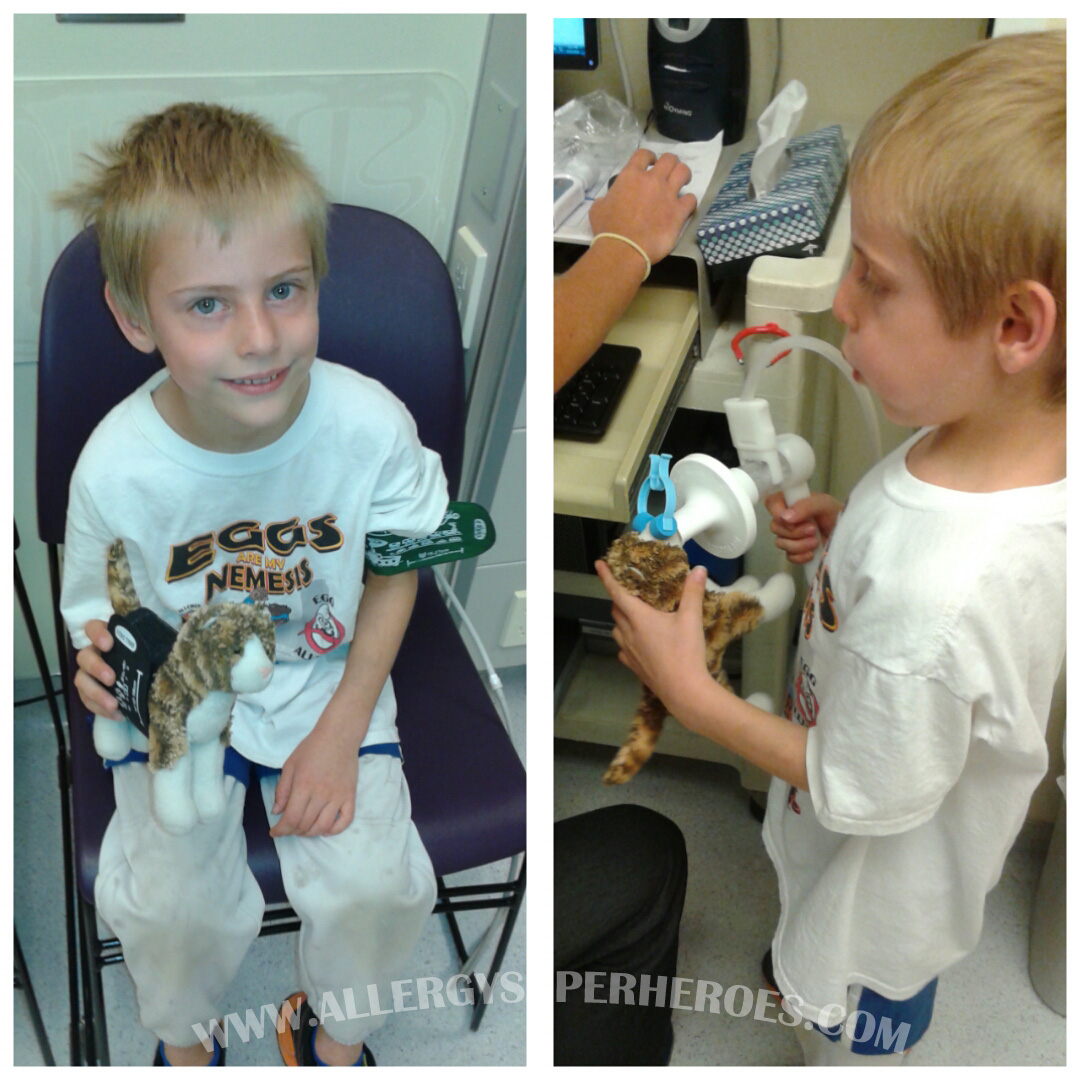
They took his vitals too, and did pulmonary function tests so they would have a baseline for later.


After his initial screening Zax did two double-blind food challenges. In both cases he ate applesauce seasoned with cinnamon and spiked with either egg protein powder or oat powder (placebo.) Neither we nor the staff knew which day was which until he reacted.

They weren't just interested in whether Zax would react, but also at what dose he would react, so they carefully gave him graduated doses at 15 minute intervals. The doses were as follows (measurements are in milligrams of egg protein powder or oat placebo.)

1, 5, 15, 50, 75, 100, 250, 500, 1000, 1250, 1750, 2250, 2750 = 9,996mg grand total (almost 10 grams if all doses are ingested)

For each day, we were scheduled for about 5 hours. The doses took 3 hours to administer (assuming he got through them all) and then we would hang out for a 2 hour waiting/observation period. If, on the other hand, Zax reacted, we would wait for observation for 2 hours following a reaction requiring Benadryl and 4-6 hours following a reaction requiring epinephrine. So 5 hours was more of a ballpark, it could be as few as 3 or as many as 7-8, depending on reactions, severity, and how far into the challenge he got before reacting.

Day 2

National Jewish has a dedicated Food Challenge Room in the Pediatric Department. This was pretty cool, because it was equipped with all sorts of activities to keep the kids occupied. We brought a backpack of toys and books along to keep Zax busy, but apart from his kitty we didn't even open it on day 2. They had movies, a Wii, toys, and crafts galore (Zax LOVES crafts, so when they called for the craft cart, he was in hog heaven!)


We started the day by getting his vitals again (and he took kitty's vitals) and then the eating began! I had explained what we were doing to Zax beforehand, several times, but we went over it again after his first dose. He wanted to know why we were coming twice so I attempted to explain the purpose of a placebo to a six-year-old. The moment I told him that it protects against him getting worried and thinking he feels a reaction when he doesn't, he pointed to his throat and said it felt a little funny. We reported that to the doctor, who suggested that he take a sip of water to see if it goes away. He did, and then buried himself in crafts, and nothing further came of it. Apparently describing the placebo effect is enough to cause a placebo effect.


There were two other boys in the the Food Challenge room (with their mothers and doctors) because the room was shared. Zax enjoyed playing with the younger of the two, who was challenging peanut for the same study Zax was in. The third boy was doing his one-year challenge for a peanut patch study--and he was getting near-constant attention from the staff. Both of the boys challenging peanut had an IV hookup in their arms so they'd be ready to administer steroids or fluids if necessary, which is hospital procedure for peanut challenge.


Before each new dose, the doctor and nurse checked Zax over, listened to his lungs, had him perform a Peak Flow test, and asked him how he felt and if he had any itchy spots.

After about 8 doses, I started doing math. I'm a numbers person, so I naturally gravitate towards them. I copied down all the doses, added up what Zax had eaten so far, calculated how much egg had been required for Zax to react previously, and thought about what all of that meant.

You see, Zax did a baked egg challenge before starting preschool, which he failed. I'd been told at the time to bake something containing 2 eggs, baked at 350 degrees for 30 minutes, and to bring in 1/12th of it. The nurse then cut the brownie I provided into four equal parts, and we fed them to Zax at 15 minute intervals. Zax felt a little funny after eating the first quarter (1/24th of an egg) but didn't report it because he wanted more chocolate. He no longer wanted any brownie after his second piece (1/12th of an egg cumulative.) If an egg is 6-7,000mg of protein, that meant that he'd started reacting at no more than 291mg, and he called the test quits at 583mg. At the time that I started calculating all of this, he had eaten 996mg of something--egg protein or placebo. I began hoping very fervently that day 2 was egg, because if it was, that would be a very good sign!

When given the option, my kid can cram a lot of crafts
into one day!

He kept eating each successive dose without issue, however, and after he ate a combined dose of more than half an egg (if it was real) I came to the conclusion that he'd been eating placebo. Zax loved the applesauce and eagerly scarfed down each dose without any issues. The room was fairly noisy and boistrous, and it became apparent after a while that all three of the kids were taking placebos that day. A random assignment to be sure, but it was nice to have everybody on the same page.

There was no eating during the test (except for the study doses), but after all doses were taken Zax was allowed to snack on foods that are safe for him. He did so, and we waited out our observation period with more crafts, games, and movies.

I didn't tell Zax that I was certain what he'd eaten was the oat powder. I told him that either it was the placebo or he'd outgrown his egg allergy. He'd approached the challenge with such confidence and enthusiasm that I didn't want to damper that with the expectation that he would definitely react at the next challenge, even though that was fully what I was expecting.

You may have noticed that Zax was wearing his "Eggs are my Nemesis" shirt for the challenges. It seemed fitting. Check out our website for gear like this to protect your little allergic superheroes!
Don't forget to use promo code BLAST15 for 15% off your order at
www.allergysuperheroes.com
4th of July weekend only!

Day 3

Zax's second challenge was four days after his first. I reiterated to him that nothing might happen that day, although when taking his first dose he told the nurse he expected it had egg in it. There was one other boy doing our study that day, accompanied by his mom and sister (who had no allergies.) The two did not get along as well, so they did not play together much, although they watched TV together.


Zax selected a craft to do and got down to work. He didn't get very far, though, because a few minutes after his third dose he told me that his throat felt funny, kind of achy/itchy. We reported this to the doctor and nurse right away.

The doc has a sense of humor, which you can see from his
shirt. He said it was a graduation gift from medical school. It says:
Allergy Information:  This shirt contains a Nut

They took his peak flow, listened to him, and asked him questions. Then, just like the previous day, they asked him to take a sip of water to see if it would make it go away. Then they told me that they'd wait a bit longer and see how he's doing before deciding if they'd do the next dose.

After maybe 10-15 extra minutes he said his throat felt mostly better so they gave him his next dose, another 50mg, bringing him to 71 total. I felt certain that the challenge would end there, but after another 15 minutes he said it still felt about the same--not totally gone, but no worse than before. So they gave him dose number five, 75mg, which brought him up to 146mg total.

Just a few minutes after that dose, he said his throat felt worse again, and worse than before. While he'd been hesitant and wanted me to report his symptoms to the doctors previously, this time he boldly told them himself, and announced that he didn't think he should eat any more. They checked him over and still didn't see much in the way of physical symptoms except possibly more stuffiness in his nose (he'd already been stuffy from seasonal allergies because he couldn't take antihistamines prior to the challenges) but everybody agreed that he should stop.

I know what they were doing when they pushed him to five doses from three. My kid had experienced a mild placebo effect on the first day, on the first dose, and as part of their study procedure they have to make sure that a patient is actually experiencing a reaction and not just a tickle in their throat or a placebo reaction. I do get that. But since the feelings never completely went away and then returned more strongly after the next few doses, there's no doubt in my mind that he was feeling a reaction on dose 3, after eating a cumulative 21 lousy milligrams. No doubt. And if he's going to react to 3/1000ths of an egg, I don't feel like he's going to grow out of this anytime soon.

We gave him a meltaway Zyrtec, which greatly surprised me. When the doc suggested it over Benadryl because it wouldn't make him sleepy, I couldn't help but grill him. Is it really as effective? I'd never considered or even heard of using a once-daily antihistamine in place of Benadryl. He said it hasn't been rigorously studied but from what they've seen, liquid or quick-dissolving Zrytec (and possibly Allegra) works as well as Benadryl for mild reactions. Zax was already starting to get drowsy from the reaction, so I decided to give it a shot rather than give him a drug that would make him even more tired.

After about 40 minutes Zax reported that he felt all the way better, but a few minutes later he gulped a bit and said he might throw up. He didn't, but he sat with the throw-up bucket nearby while staring mindlessly at the TV for another half hour or so.


Once he started to perk up, I broke out the consolation prize--a new Lego set. We even found a better use for the throw up bin!

I realized after the fact that I'd been taking pictures through the whole procedure, but I hardly took any while Zax was reacting. Too preoccupied with my child's welfare to think of the camera. For a while he looked really run-down, with bloodshot eyes and circles under them. Once all of that cleared and his behavior perked back to a semblance of normal, I knew he was feeling better.

By the time we left, Zax was basically himself but still a little worn out. It's rough to have an allergic reaction, even if it isn't anaphylactic. Especially if you ate more than you probably should have. He was tired all afternoon and didn't have his normal energy level again until the next morning. I'm happy to report that the next morning wasn't at all affected by the reaction, and he played soccer without a hitch. We had Epis on hand as per doctors orders (which we always do anyway) in the time following the challenge just in case of a biphasic reaction, but fortunately he was fine.


It was weird intentionally inducing an allergic reaction in my son. I was never scared for his life--after all, there's no safer place to have an allergic reaction than in a hospital surrounded by doctors who do this all the time--but I was worried about him, especially going into Day 3. Even though there had always been a chance that he'd react to the first challenge, it somehow felt worse the second time, and probably because I knew that something was going to happen that day. I was doing my best not to pass anticipation or anxiety on to him, and I think I succeeded, but that doesn't mean it was easy.

I am glad, however, that we're contributing to the advancement of food allergy science. This new blood test may someday replace RAST testing, or it may fizzle and die off, but we're helping determine if it works, and that's a worthwhile achievement.

There was one silver lining to Zax's reaction, other than the obvious contribution to medical science. I quiz him regularly on what he's supposed to do during an allergic reaction, and I introduce different scenarios for him to think through. A few months before this study, I asked him if he remembered what an allergic reaction felt like and he said no, not really. Then he suggested that maybe he should try something he's allergic to again so he can remember.

I am a fan of knowing what you're dealing with. When I first read the story of B.J. Hom's death, I couldn't get past the detail that he asked his father for cough drops because his throat hurt. He didn't know he was having an allergic reaction, and so neither did anyone else in his family. I was stunned than anyone with food allergies could make it to the age of 18 without knowing what an allergic reaction felt like--because my own childhood was riddled with accidental exposures that, among other things, didn't allow me to forget that telltale sensation. So the fact that someone could die of an allergic reaction because they didn't even recognize what was happening scared me. A lot.

It scared me so much that it has colored the way I parent. Every time one of my kids has had an allergic reaction, I've asked them to think carefully about how they feel and to remember it, and if they ever feel that way again, they're to tell an adult right away. Because really, none of the words we use to describe an allergic reaction quite does it justice. They're close, and good guides to be sure, but it's a unique feeling that lacks an appropriate descriptor.

So there was Zax, at the wise old age of 6, admitting that he didn't remember an allergic reaction (it had been a few years) and suggesting that he needed a reminder. This study certainly gave him that reminder, and there was no safer place to do it. And if that experience can keep my child safer, then it was time well spent.